
Long before power looms, Ahmedabad was one of the great silk weaving cities of India. From the time of the Gujarat sultans and on through Mughal rule, its workshops turned out rich patterned silks for courts, merchants and temples at home, and for buyers across the Indian Ocean. Some of the finest of these were woven in a technique called lampas, which let the weaver set crisp, raised figures of pale silk against a deep coloured ground.
Lampas is a compound weave, and it needs two sets of warp threads on the loom instead of one. The main warp and its weft make the plain ground, here a strong red. A second, finer warp is used only to tie down the extra coloured wefts that form the pattern, so the figures sit on the surface in neat little floats while the ground stays smooth underneath. Every repeat of the design had to be set up on a drawloom, with a helper lifting groups of threads in the right order for each pass of the shuttle. It was slow, skilled work, and it was why such silks were costly.
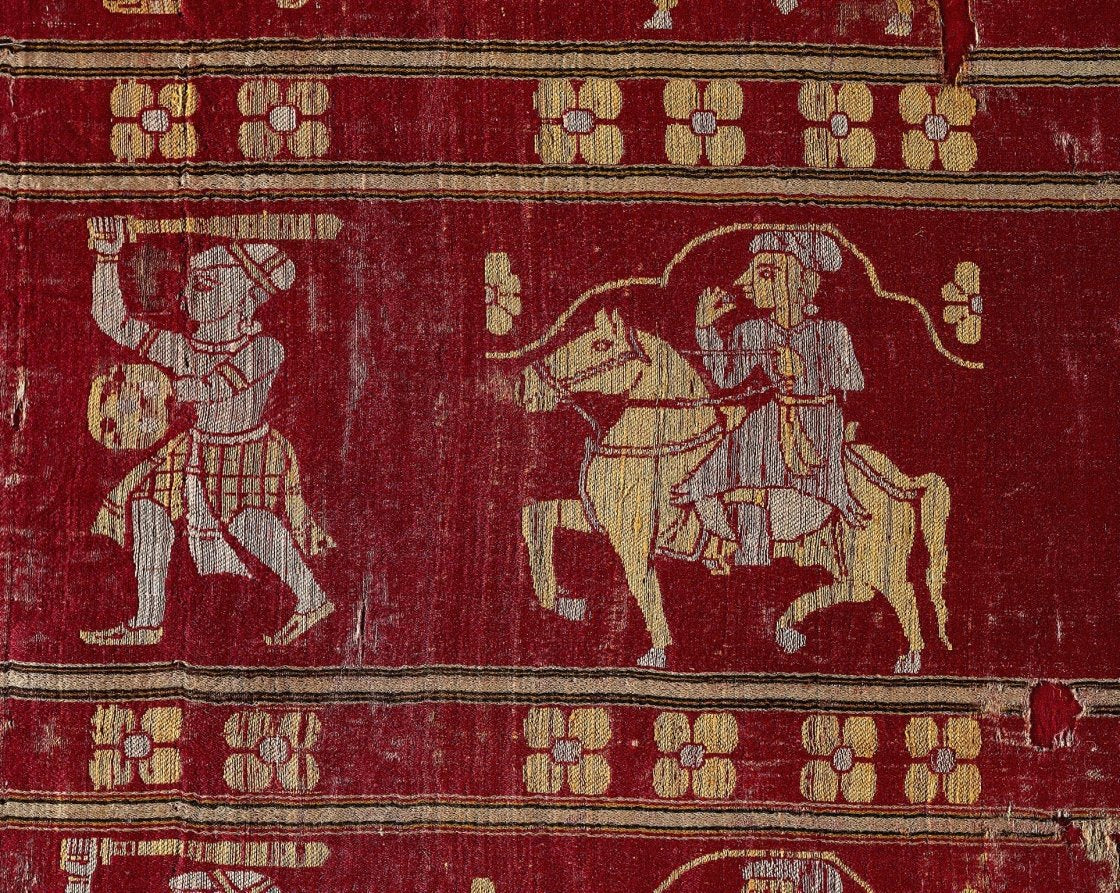
The photo shows part of a larger tent hanging woven in Ahmedabad between about 1560 and 1610, now in the Cleveland Museum of Art. It measures about 94 by 172 centimetres. On a red silk ground, rows of figures in cream, gold and pale blue march between narrow striped bands. A foot soldier raises a sword above his head and carries a round shield. Beside him a rider in a turban sits on a prancing horse, his hand raised to his face, under a looping canopy line. Between the rows run borders of small four-petalled flowers. The same figures repeat along each band, as they would across the whole tent.
Hangings like this lined the walls of the large tents used by rulers and nobles when they travelled or held court outdoors, turning a camp into a bright, patterned room. Soldiers, riders and flowers were natural subjects for such a setting. Few of these silks survive, since tents were packed, moved and used hard, which makes even a fragment like this a rare record of what Ahmedabad's looms could do.
The photo on this post is not from the shop, and we do not sell this hanging. For handcrafted pieces we do carry, browse our collections.
Photo, resized for this page: Tent Hanging (Part of a Larger Piece), 1560–1610, India, Gujarat, Ahmadabad, silk, lampas weave, Cleveland Museum of Art 1953.474, gift of George P. Bickford (source, CC0 1.0).
— The Indian Artifact
