
The Jats of Kutch are a pastoral Muslim community whose families came into Kutch from Sindh and the lands further west generations ago. Many settled in and around Banni, the grassland north of Bhuj, where they kept cattle and camels and moved with the seasons. Like other herding communities in Kutch, the Jats have their own way of dressing, and the women's embroidery is one of the clearest signs of who they are.
Jat embroidery is known for being small, dense and very even. Women work with fine silk or cotton thread, building up tight geometric patterns of squares, diamonds and tiny flowers until the stitching almost covers the cloth. Small round mirrors are set in among the stitches, held in place with a ring of thread so that they catch the light whenever the wearer moves. The work is done by eye and counted by hand, and it was taught from mother to daughter, with girls stitching pieces for their own dowry.
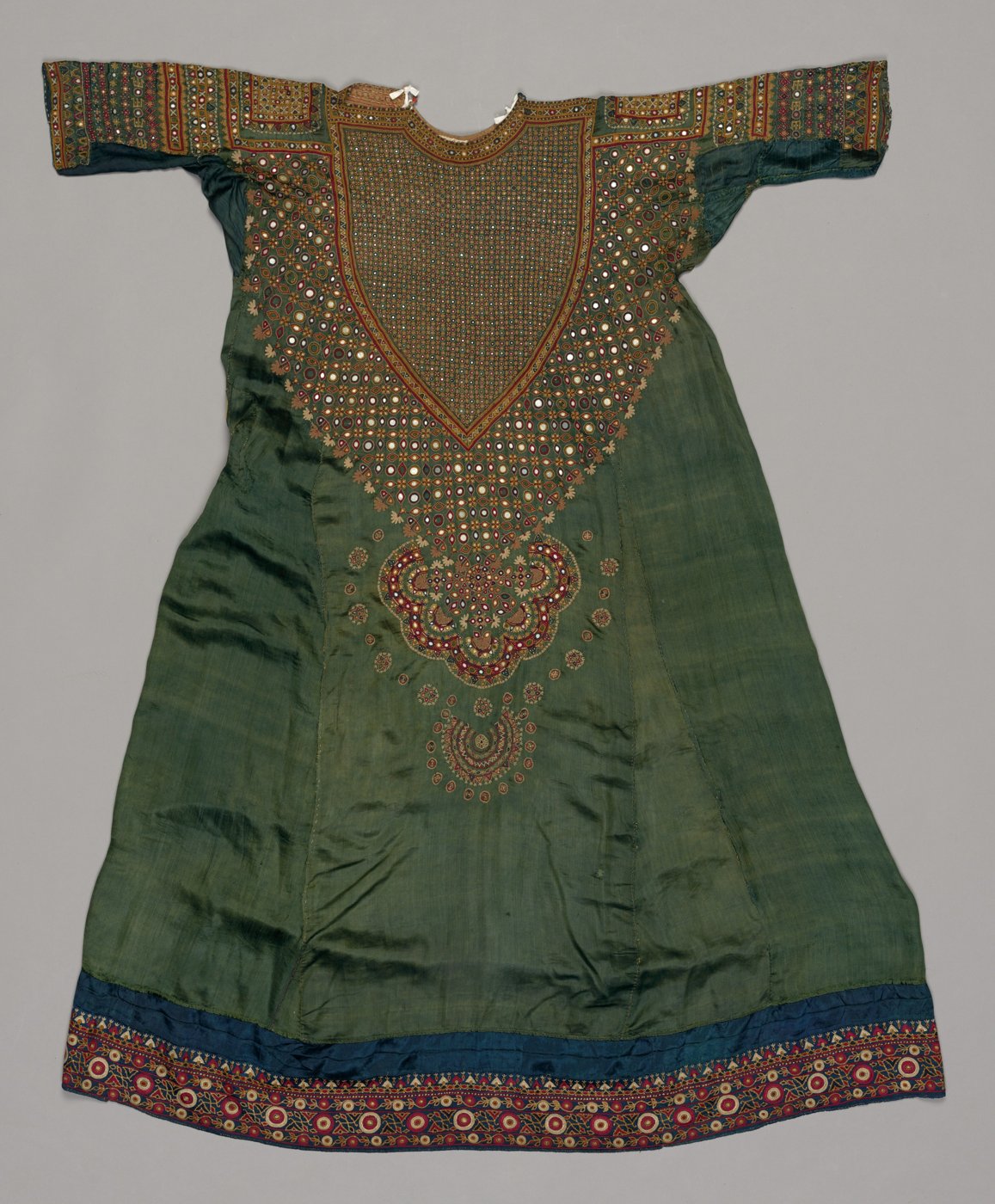
The photo shows a Jat woman's dress made in the 1800s, probably in Kutch, now in the Cleveland Museum of Art. It is a long, loose dress of dark green silk, about 129 centimetres long. The front is heavy with work. A shield shaped panel below the neck is filled with a fine grid of stitching, and around it spreads a wide yoke of tiny mirrors in rings of red, yellow and cream thread. Below the yoke hangs a scalloped medallion, then a smaller half circle, and the shoulders and sleeves carry bands of mirrors and squares. Near the hem a blue band and a border of red and cream rosettes finish the dress. The museum lists the stitches as open chain, stem, basket and running stitch, all in silk.
The rest of the dress is left plain, so the green silk sets off the bright work on the chest. That contrast, a calm ground with a crowded, glittering yoke, is part of what makes Jat dress easy to recognise among the many embroideries of Kutch. Jat women still embroider today, and their work now also reaches buyers far beyond the villages of Banni.
The photo on this post is not from the shop, and we do not sell this dress. For handcrafted pieces we do carry, browse our collections.
Photo, resized for this page: Jat Woman's Dress, 1800s, Western India, Gujarat, possibly Kutch, silk embellished with mirror work and embroidered with silk in open-chain, stem, basket and running stitch, Cleveland Museum of Art 1916.1467 (source, CC0 1.0).
— The Indian Artifact
