
Jain teaching has a very exact picture of the universe. It is not a vague heaven above and an underworld below, but a measured world of continents, oceans, mountains, heavens and hells, each with its place and its name. To help monks, nuns and lay people hold that picture in mind, painters in western India made large diagrams of the universe on cotton cloth. Gujarat, with its old Jain communities and busy workshops, was one of the main places where these cloth paintings were made.
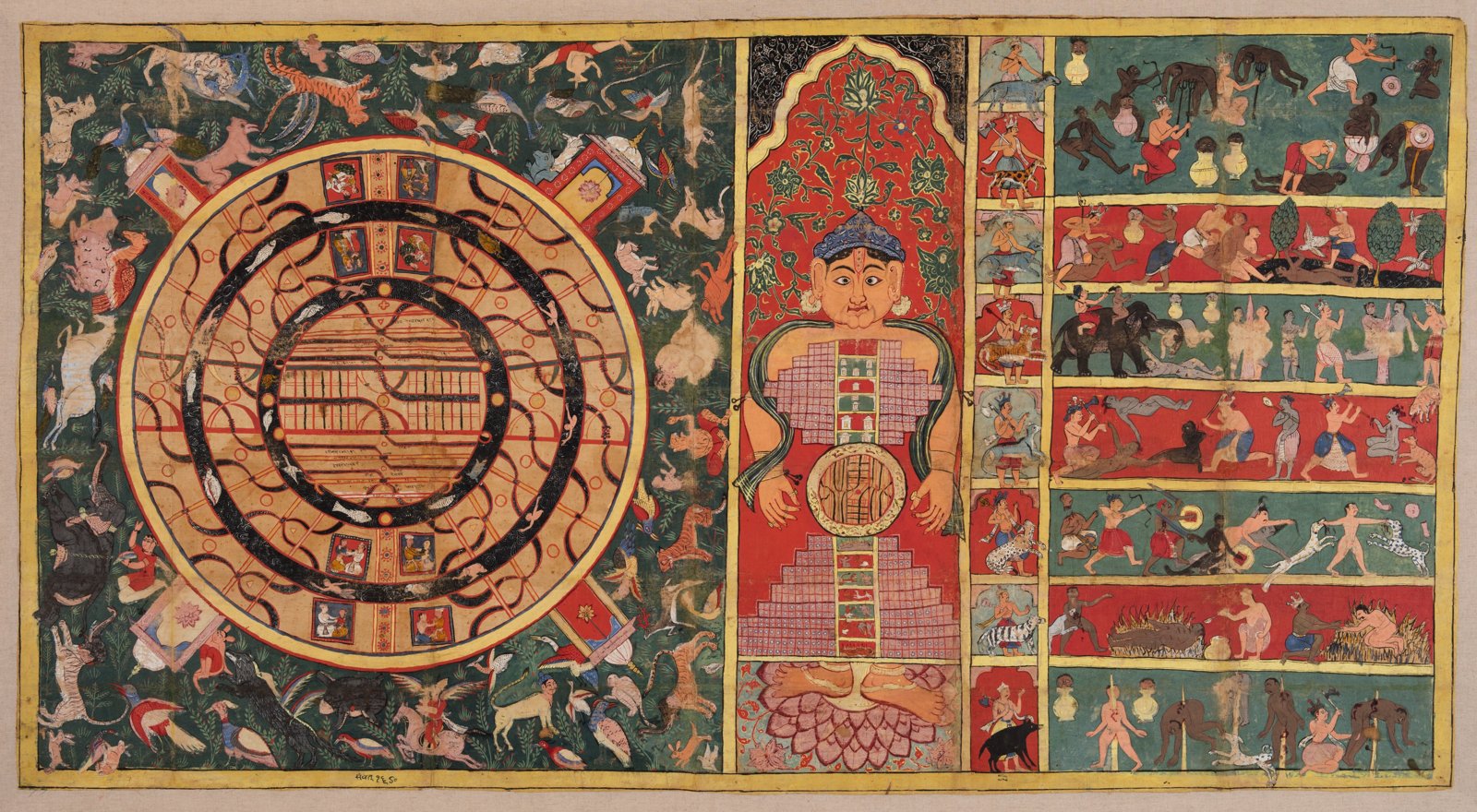
Two subjects come up again and again. The first is the Adhai Dvipa, the "two and a half continents", the part of the universe where Jains believe humans can live. It is drawn as a set of rings. At the centre is the round continent of Jambudvipa with the great mountain Meru in its middle, crossed by mountain ranges and rivers. Around it runs a ring of ocean, then another continent, another ocean, and finally half of a third continent. The second subject is the Loka Purusha, the universe in the shape of a standing person. The heavens are stacked in the upper body, the hells in the legs, and the narrow middle world of humans and animals sits at the waist.
The photo shows a cloth painting from Gujarat dated 1613, now in the Cleveland Museum of Art. It is about 84 by 155 centimetres and is painted in gum tempera, ink and gold on cloth. In the centre stands the cosmic person under a painted arch, the body built of stepped pink bands with a small round diagram at the waist. On the left that middle world is shown again at a much larger size, as a great circle of rings and rivers, with tigers, elephants, deer, birds and fish crowding the dark green ground around it. On the right, rows of small scenes on red and green grounds show the seven levels of hell, where figures suffer the punishments described in Jain texts.
These paintings were tools for teaching and reflection as much as works of art. A teacher could point to a ring or a level and explain where souls are born and why, and a viewer could see at a glance how small the human world is within the whole. Painters followed set rules for the layout, but each workshop added its own colours, borders and lively animals, so no two cloths look quite the same.
The photo on this post is not from the shop, and we do not sell this painting. For handcrafted pieces we do carry, browse our collections.
Photo, resized for this page: Diagrams of the Universe: The Two-and-a-Half Continents, the Universe in the Shape of a Person, and the Seven Levels of Hell, 1613, Western India, Gujarat, gum tempera, ink and gold on cloth, Cleveland Museum of Art 2018.201 (source, CC0 1.0).
— The Indian Artifact
